Some of grappling's biggest stars took the mats at WNO 26 last Friday and we had one dozen matches full of action. There's a lot for grappling fans to appreciate on a tactical and technical level whenever the best-of-the-best meet up and we picked out five major lessons and moments that really stand out.
Roberto Jimenez's Flying Armbar
We kind of have to start here, with the early frontrunner for submission of the year. Roberto Jimenez jumped to the flying armbar and scored the second fastest submission in WNO history, a shocking result against someone as tough as Elder Cruz. It's the perfect representation of the wild man that we have gotten to see mature in this sport. Now, he looks ready to contend with anyone in the division.
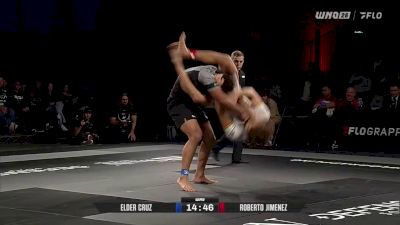
So how'd he do that? First off, Elder clearly was being heavy with the collar tie and anchored himself into the tie up in typical wrestler fashion. If you look back, that's also how he lost to Carrozzino at No-Gi Worlds when his collar tie got slid by for a back take.
Here, Roberto grabbed the head with both hands in an overtie and jumped his hips to the shoulder. Once he connected, he moved his hands down the arm to trap the wrist and hip in for the hyper-extension of the elbow. It's a stunning submission that brought the crowd to their feet.
While the flying armbar is relatively simple in terms of steps, it takes many, many repetitions to gain the timing necessary to hit it at this level. It also must be noted that there's an incredible risk to the person jumping that they can land on their head or neck, which can cause traumatic injury or even death. For anyone out there aiming to copy this submission, do so under the guidance of a qualified instructor.
Pato's Reversal To Mount
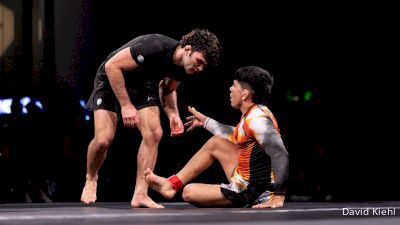
Diego Pato got pushed hard in the main event but still did more than enough to get his hand raised by decision. Early on, though, it didn't look like it would last that long. 23 seconds into the match (at the 3:29 mark in the above video) Keith Krikorian went to pass up over the top with a rolling kimura trap. The issue? Diego Pato trains with the Mendes brothers, the best ever at rolling over the top of the guard.
Pato's reversal is a clear learned counter to a common tactic that the Mendes brothers used regularly in their competition careers (primarily in front headlocks, and particularly Rafa). Over the top offense against the guard is an unpredictable way to add to your passing game, forcing your opponent into a scramble that you can control by latching onto a front headlock or kimura grip. Against guards where your opponent is insisting on a sitting posture, it's a great option.
But Pato knows all this, because he trains at AOJ. Even if he isn't directly getting those looks from Rafa and Gui, he still will see that shadowed and imprinted on the students games at the gym. Gyms tend to find the style of the instructor over time and AOJ is no exception (given what we see in competition).
So what did Pato do? He rolled through and freed his upper body so that he could connect his hips and mount. It is a lightning-quick transition that he has likely had to hone in the gym many times over. Here, we see almost an inoculation effect - Pato has been exposed to that offense so many times that he has built up a solid immunity.
Sarah Galvão's Use Of The Triangle
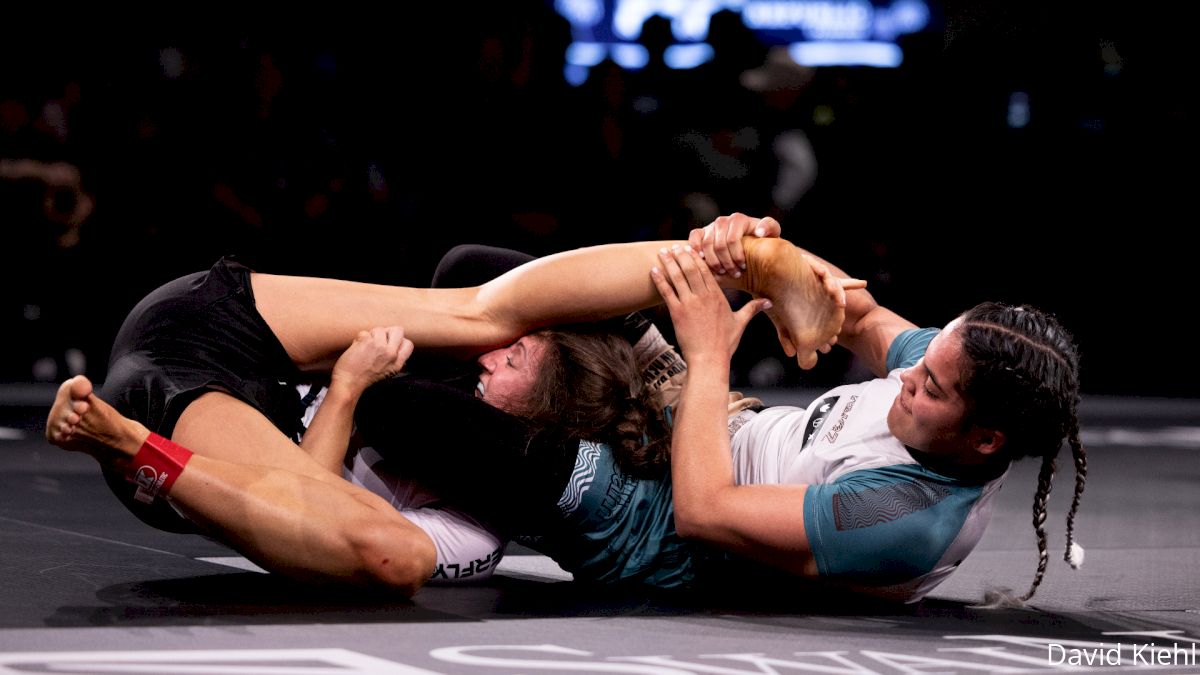
The triangle choke is a multi-purpose grappling weapon and we saw a great example of that in Sarah's match against Katie Carr at WNO 26. She would lock into a rear triangle pretty quickly into the match - and that's really where things got interesting.
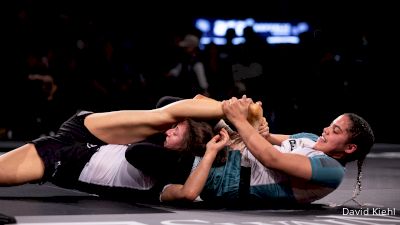
Obviously the main goal of any triangle choke is going to be to use that choke to get the strangulation necessary for the tap. Still, it can be a real battle of minor angles and sometimes the choke finish isn't happening. That's when the triangle's secondary benefit comes out; you can use it as a staging position to attack joint locks.
The triangle locks the person into one spot and forces them to deal with that choke threat nonstop. While that's happening, Sarah was able to transition to a combination attack by first working to hyper-extending the leg for a kneebar variation and then finally finishing by torqueing the arm with an americana variation. The triangle, despite not finishing the fight, was key to the submission.
Isaac Cordova's Side Control Escape
There was a really novel side control escape in the undercard's final bout of Zach Kaina vs Isaac Cordova. Cordova, despite the loss, used a side control escape that worked like a charm against black belt world no-gi champion Kaina and is worth taking a better look at.
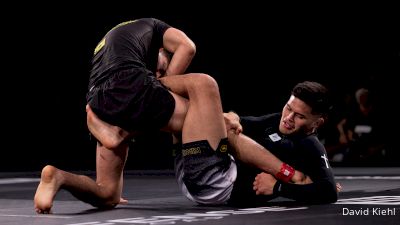
Starting at 9:24 of the video file above, Isaac is stuck in side control with Zach really committed to pinning him down. Isaac takes a few interesting steps;
- He steps over the near calf, creating a hook on the foot and knee.
- He pummels in a near-side underhook and gets up on his side.
- He reaches for the far foot and holds the top of the arch.
- He pushes in and then rolls back across his shoulders to end up on top.
This reversal is reminiscent of the coyote half guard popularized by Lucas Leite, with the key difference of being hooked over the knee in side control instead of around the knee from half guard. While it's never ideal to end up in side control, this interesting escape could help you next time you are there.
Paige Ivette's Rolling Escapes
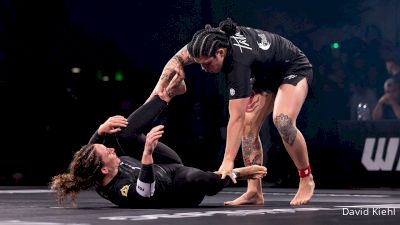
I think we are currently in an era where the front headlock is key to consistently winning at a high level. People have adjusted to the leg entanglements and there's now a correction back to the other end of the body where people are most consistently attacking the front headlock. That's usually with arm triangle variations like the darce, anaconda, or seated katagatame (which Tainan subbed Rene with) but also guillotines and other more niche techniques.
That, of course, means that everyone's front headlock escapes must improve. Rafaela specifically has a great front headlock that she has used to submit at the highest level. She went to it again and again in her WNO match - and Paige escaped every time. Most impressive were her rolling escapes, where she would go across her own back to roll up into a safer position - similar to a rotational escape from the heel hook.
For the front headlock submission to typically be successful, the attacker must eventually attach their hips to the opponents. This can be in full guard, some kind of open guard, or anything in between - but it increases the power of the choke by a significant magnitude. Paige showed how rolling can help disrupt this attachment and force the opponent to either lose position or base back out.
Just like how rotational escapes became a must-have for leg lock defense, so must they become a regular part of any elite grappler's defense to front headlocks. Paige showed the value of this against an elite front headlock and extended this match into a classic WNO contest.
Watch BJJ On FloGrappling
FloGrappling is the streaming home to the best Brazilian Jiu-Jitsu events and news coverage. FloGrappling is the streaming home of:
Join The BJJ Conversation By Following FloGrappling On Social
- Follow us on Twitter @flograppling
- Follow us on Instagram @flograppling
- Watch us on YouTube
- Like us on Facebook